Four Kingdoms, Part III
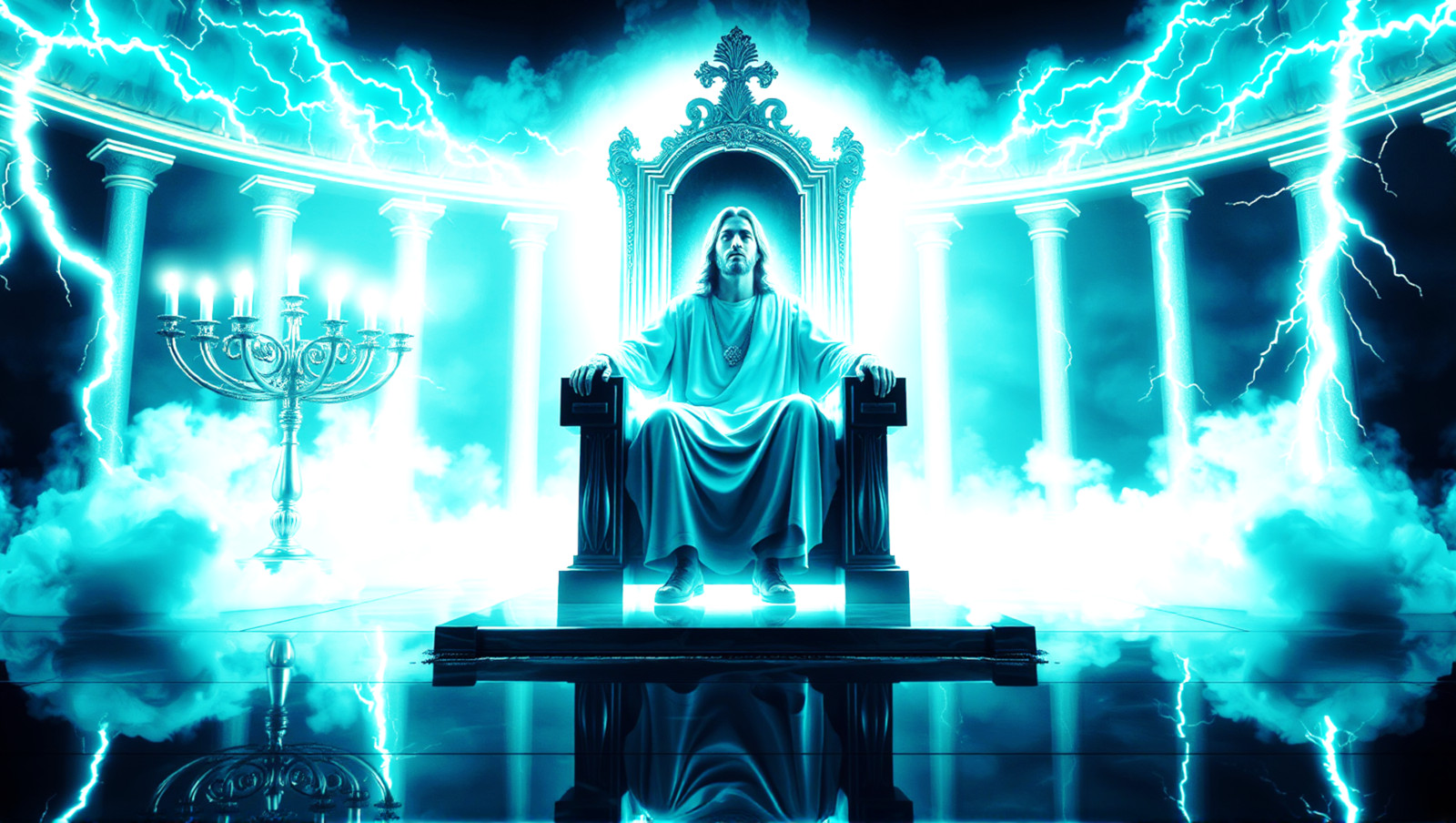
The Scriptures mention four kingdoms: 1) the kingdom that was to be established in the land of Israel; 2) the kingdom that will be established during a thousand‑year period; 3) the heavenly kingdom; and 4) the kingdom that will be established in the hearts of people. If these are not distinguished clearly, it becomes complicated and difficult to understand. Therefore, there is a need to explain them one by one. III The Kingdom in Heaven The Kingdom of Heaven Seen by Isaiah 1. I saw the Lord, high and exalted, seated on a throne; and the train of his robe filled the temple. (Isaiah 6:1) Then the king made a great throne covered with ivory and overlaid with fine gold. The throne had six steps, and its back had a rounded top. On both sides of the seat were armrests, with a lion standing beside each of them. 20 Twelve lions stood on the six steps, one at either end of each step. Nothing like it had ever been made for any other kingdom. (3 Kings 10:18-20). The Lord who created all things and is the only God has a throne of such surpassing greatness that His robe fills the temple, as Scripture affirms. Just as bridesmaids wear exceptionally long gowns to enhance their elegance at weddings, so too does God's magnitude ensure His robe spans the entire heavenly sanctuary. It is important to note that this temple is not located on earthly ground but exists in heaven itself. 2. Above him were seraphim, each with six wings: With two wings they covered their faces, with two they covered their feet, and with two they were flying. Angels in heaven appear to exist in various forms. In this vision, the angels seen by Isaiah is identified as seraphim, with each possessing six wings. While humans can only observe birds and flying creatures, which typically have two wings, it is worth noting that cicadas possess four delicate wings that beat rapidly in a manner reminiscent of a helicopter's rotor. 3. And they were calling to one another: “Holy, holy, holy is the Lord of Hosts; the whole earth is full of his glory.” Why is God called "the Lord of Hosts"? The word "hosts" refers to an army. God is called the Lord of Hosts because He is a warrior who fights. The angels in heaven proclaim, "Holy, holy, holy," as they say repeatedly. John saw similar scene: "Each of the four living creatures had six wings and was covered with eyes all around, even under its wings. Day and night they never stop saying: “‘Holy, holy, holy is the Lord God Almighty,’ who was, and is, and is to come.”(Revelation 4:8). Holiness is one of God's attributes; thus, praising Him for His holiness is an act of worship. Yet, continuous praise is impossible for humans bound by time and physical limitations. While heavenly beings can sustain such perpetual worship, weary human minds often fail to comprehend it. 4. At the sound of their voices the doorposts and thresholds shook and the temple was filled with smoke. Why did the doorposts tremble and become filled with fire? It was because of His great power. Why was the entire house filled with fire? Because it was full of God's glory. Moses wrote: "Mount Sinai was covered with smoke, because the Lord descended on it in fire. The smoke billowed up from it like smoke from a furnace, and the whole mountain trembled violently. (Exodus 19:18). The trumpeters and musicians joined in unison to give praise and thanks to the Lord. Accompanied by trumpets, cymbals and other instruments, the singers raised their voices in praise to the Lord and sang: “He is good; his love endures forever.” Then the temple of the Lord was filled with the cloud, and the priests could not perform their service because of the cloud, for the glory of the Lord filled the temple of God. (2 Chronicals 5:13-14). 5. “Woe to me!” I cried. “I am ruined! For I am a man of unclean lips, and I live among a people of unclean lips, and my eyes have seen the King, the Lord Almighty.” 6. Then one of the seraphim flew to me with a live coal in his hand, which he had taken with tongs from the altar. An angel took a live coal from the altar and placed it on Isaiah's lips to purify him, removing his sin. The altar served as the place where sacrificial offerings were made to atone for sins. The Kingdom of Heaven Seen by John Revelation 4 2. At once I was in the Spirit, and there before me was a throne in heaven with someone sitting on it. The phrase "caught up in the Spirit" indicates that John was completely filled with the Holy Spirit, not merely physically present; he was transported to heaven by the Spirit's power to behold the throne. The description of the One sitting upon the throne is provided in verse 3. 3. And the one who sat there had the appearance of jasper and ruby. A rainbow that shone like an emerald encircled the throne. Although John witnessed God, he described only specific colors: jasper (a translucent stone), sapphire (often interpreted as a deep blue or violet gemstone), and flames of fire around the throne that appeared like an emerald green. These vivid symbols represent the eternal covenant between God and humanity on earth. Whenever I bring clouds over the earth and the rainbow appears in the clouds, I will remember my covenant between me and you and all living creatures of every kind. Never again will the waters become a flood to destroy all life. Whenever the rainbow appears in the clouds, I will see it and remember the everlasting covenant between God and all living creatures of every kind on the earth.” (Genesis 9:14-16). This rainbow serves as a sign of God's mercy; whenever we see it, it reminds us of His enduring love and His promise never to destroy the Earth. However, today some people have repurposed the rainbow as a symbol for same-sex relationships. Regardless of how the symbol is used, any behavior that constitutes an offense to God will not be shielded from divine judgment. 4. Surrounding the throne were twenty-four other thrones, and seated on them were twenty-four elders. They were dressed in white and had crowns of gold on their heads. Who are these twenty-four elders seated on the twenty-four thrones? According to the King James Version and other translations, they represent the Church of believers. John wrote: And when he had taken it, the four living creatures and the twenty-four elders fell down before the Lamb. Each one had a harp and they were holding golden bowls full of incense, which are the prayers of God’s people. And they sang a new song, saying: “You are worthy to take the scroll and to open its seals, because you were slain, and with your blood you purchased for God persons from every tribe and language and people and nation. You have made them to be a kingdom and priests to serve our God, and they will reign[a] on the earth.” (Revelation 5:8-10). Since the text uses the first-person plural ("we"), these elders are speaking about themselves. Having come from every tribe and tongue on earth, they were redeemed by the blood of the Lamb for God's purpose and now serve as priests before God in heaven. As stated in 1 Peter 2:9, this refers to believers who wear white robes because they have been cleansed and made righteous. Furthermore, Revelation 19:7-8 describes them as His bride, noting that "fine linen, bright and clean," was given her to wear. "The elders wore golden crowns upon their heads." These golden crowns were bestowed upon the overcomers rather than serving as hereditary royal diadems. While a royal crown is passed down by inheritance, the crown of victory is earned through personal effort and perseverance. 5. From the throne came flashes of lightning, rumblings and peals of thunder. In front of the throne, seven lamps were blazing. These are the seven spirits[a] of God. Lightning, thunder, and loud voices symbolize the power and majesty of God. He reveals His glory to humanity through these phenomena, as seen when He spoke to the Israelites on Mount Sinai. " When the people saw the thunder and lightning and heard the trumpet and saw the mountain in smoke, they trembled with fear. They stayed at a distance and said to Moses, “Speak to us yourself and we will listen. But do not have God speak to us or we will die.” Moses said to the people, “Do not be afraid. God has come to test you, so that the fear of God will be with you to keep you from sinning.” The people remained at a distance, while Moses approached the thick darkness where God was. Idols and Altars Then the Lord said to Moses, “Tell the Israelites this: ‘You have seen for yourselves that I have spoken to you from heaven:" (Exodus 20:18-22). When God revealed His power, the Israelites were terrified. In contrast, today many people do not perceive or hear God's glory and consequently do not fear Him. "Seven Spirits of God": Here, the Holy Spirit is likened to oil used in lamps; just as oil provides the fuel necessary for a lamp to shine, the Holy Spirit brings spiritual illumination and life to people. 6. Also in front of the throne there was what looked like a sea of glass, clear as crystal. In the center, around the throne, were four living creatures, and they were covered with eyes, in front and in back. The sea of glass must represent the bronze basin at the front of the throne, in which water is stored; with that water, priests are cleansed and purified, and sacrificial animals are also washed. Since purification by water is required when offering sacrifices to God, the heavenly sea appears to illustrate this cleansing process. "Four living creatures full of eyes all over their bodies." These four living creatures are said to be fully covered with eyes. Eyes reveal sight. Since humans have two eyes, they can only see the front and sides but not the back. Having eyes all over their bodies indicates that they can see in all directions. These four living creatures also appear in the following verses: Exodus 25:6-14, 26:1-8, 37:3, 38:4, 39:4. 7. The first living creature was like a lion, the second was like an ox, the third had a face like a man, the fourth was like a flying eagle. Prophet Ezekiel also saw these creatures: "I looked, and I saw a windstorm coming out of the north—an immense cloud with flashing lightning and surrounded by brilliant light. The center of the fire looked like glowing metal, and in the fire was what looked like four living creatures. In appearance their form was human, but each of them had four faces and four wings. Their legs were straight; their feet were like those of a calf and gleamed like burnished bronze. Under their wings on their four sides they had human hands. All four of them had faces and wings, and the wings of one touched the wings of another. Each one went straight ahead; they did not turn as they moved. Their faces looked like this: Each of the four had the face of a human being, and on the right side each had the face of a lion, and on the left the face of an ox; each also had the face of an eagle." (Ezekiel 1:4-10) Humans dwelling on earth cannot fully comprehend these creatures. These four living creatures correspond to the four Gospels' portrayals of Jesus Christ. Matthew depicts Christ as a lion, symbolizing His kingly lineage beginning with Abraham; Mark depicts Him as an ox, representing His servant role and omitting genealogy in favor of tracing it to John the Baptist, the Servant of God; Luke portrays Him as a man, illustrating His humanity and descending genealogical line from Adam; and John portrays Him as an eagle, signifying His divinity and ascending genealogy originating from God Himself. As these creatures dwell nearest to God's throne, they may represent angels. 8. Each of the four living creatures had six wings and was covered with eyes all around, even under its wings. Day and night they never stop saying: “‘Holy, holy, holy is the Lord God Almighty,’ who was, and is, and is to come.” These creatures are angels; while Ezekiel saw four wings on each, their six wings in Revelation indicate a higher order of worship. The fact that they are covered with eyes all over signifies their ability to see everything simultaneously. The continuous proclamation—"Holy, holy, holy..." without ceasing—is difficult for humans to comprehend because we experience fatigue and weariness, whereas in heaven there is no such limitation. Consequently, since there is no day or night, there is also no need for rest. This statement was written so that people on earth can understand its meaning: it represents an unceasing declaration. The creatures' proclamation focuses not on God's grace but on the praise of His glory. Since believers will similarly praise Him in heaven, we should now begin to praise God's glory as well. 9. Whenever the living creatures give glory, honor and thanks to him who sits on the throne and who lives for ever and ever, As the four living creatures proclaim the glory and honor of the One seated on the throne who lives forever, they declare that He is the Lord God Almighty—He who was, is, and is to come. The term "forever" signifies eternal existence, pointing directly to the majesty and nature of God. Through this worship, they celebrate His glory and honor. 10. the twenty-four elders fall down before him who sits on the throne and worship him who lives for ever and ever. They lay their crowns before the throne and say: “You are worthy, our Lord and God, to receive glory and honor and power, for you created all things, and by your will they were created and have their being.” The twenty-four elders fall down before the eternal God and worship Him; bowing signifies humility. Believers today do not perform such prostrations because God dwells in heaven while humans remain on earth. The elders praise God as the Creator, worthy of glory, honor, and power. They also lay their crowns at His feet without retaining them, as these crowns symbolize their victories. By placing their crowns before Him, they demonstrate humility and reverence. No one deserves to boast before God, yet today people are far from Him, taking pride in their own abilities, strengths, achievements, and possessions. If those individuals stood before God, no one would dare act that way. Therefore, we must recognize that we stand before God now and live humbly. The New Heaven and the New Earth Seen by John Revelation 21 1. Then I saw “a new heaven and a new earth,” for the first heaven and the first earth had passed away, and there was no longer any sea. 2. I saw the Holy City, the new Jerusalem, coming down out of heaven from God, prepared as a bride beautifully dressed for her husband. 3. And I heard a loud voice from the throne saying, “Look! God’s dwelling place is now among the people, and he will dwell with them. They will be his people, and God himself will be with them and be their God. God's dwelling place is where He resides in fellowship with mankind. Currently, God does not dwell among humanity because people still carry sin and are not yet united with the holy God. Humanity resembles orphans living on earth without a Father; we have been separated from God since the beginning. While people can survive physically apart from God, just as orphans long for their parents, humanity yearns for its Creator. 4. ‘He will wipe every tear from their eyes. There will be no more death’a]"> or mourning or crying or pain, for the old order of things has passed away.” In the new heaven, there will be no tears; indeed, these are the final tears of all. Because God Himself wipes them away, people will rejoice and exult. This demonstrates God's love, care, and compassion toward His people. In heaven, there will be no death—the thing most feared and detested by humanity—making its absence a cause for profound joy. There will also be no sorrow, weeping, or pain; therefore, we should eagerly long to reach that state. Yet, why do believers not always crave heaven? It is because worldly things are too tempting. The statement "the former things have passed away" refers to the present world in which I now live. The Key to Enter Heaven Even though we may understand something about the Kingdom of Heaven, there is no benefit unless we personally enter it. Therefore, I wish to explain how one may gain entry into the Kingdom of Heaven. People generally believe that by practicing good deeds, performing good works, having a deep interest in God's Word, obeying His commandments, registering as church members, receiving baptism, repenting of sins, and giving alms, they can secure passage into heaven. Driven by this belief, people strive to accomplish these things. However, none of these actions can grant access to heaven. When Nicodemus asked Jesus about entering the Kingdom of Heaven, Jesus replied, "Truly, truly, I say to you, unless one is born again, he cannot see the kingdom of God" (John 3:3). Nicodemus then asked, "How can a man be born when he is old? Can he enter his mother's womb again and be born?" Jesus answered, "That which is born of flesh is flesh, and that which is born of the Spirit is spirit" (John 3:6). Why can one not enter heaven through good deeds, good works, a deep interest in God's Word, obedience to His commandments, church membership, baptism, repentance, or almsgiving? The reason is that the Kingdom of Heaven does not belong to this world; it exists in heaven. The Kingdom of Heaven is a spiritual realm, whereas this world is physical. This Kingdom that will be established in Israel is on earth; therefore, those who have sinned can enter that Kingdom through repentance. For this reason, John preached in Judea, saying, "Repent, for the Kingdom of Heaven is at hand" (Matthew 3:2). Jesus also said, "Repent, for the Kingdom of Heaven is near" (Matthew 4:17). The Kingdom established in a thousand years will also be on earth, so people can enter it through repentance. Regarding this matter, Scripture declares: "And I will pour out on the house of David and the inhabitants of Jerusalem a spirit of grace and supplication. They will look on me, the one they have pierced, and they will mourn for him as one mourns for an only child, and grieve bitterly for him as one grieves for a firstborn son." (Zechariah 12:10) “Look, he is coming with the clouds,” and “every eye will see him, even those who pierced him”; and all peoples on earth “will mourn because of him.” So shall it be! Amen." (Revelation 1:7) These passages indicate that when Jesus returns in His glory as King, the Israelites who pierced Him will weep and mourn as a result of their repentance. This group will not die during the great tribulation but will physically pass through it, witnessing Christ's coming and entering the thousand-year reign. They are those who will enter the Kingdom of a thousand years. These are those who will enter the kingdom of a thousand years. Through the Second Birth The Kingdom of Heaven, which will be established in heaven, exists apart from this physical world. As Jesus told Nicodemus, one must be born again—born of the Spirit. He declared, "That which is born of the flesh is flesh, and that which is born of the Spirit is spirit" (John 3:6). This signifies that the Kingdom of Heaven is not a physical kingdom but a spiritual realm; therefore, Jesus emphasized being born of water and the Spirit. Regarding the concept of being "born of water," it is commonly assumed to refer to immersion in water or pouring water over the head. However, Scripture identifies three distinct types of "water": (1) the physical water we drink, (2) the Holy Spirit, described as "living water" (John 7:37-39), and (3) the Word of God, which is likened to water for cleansing (Ephesians 5:26). Consequently, the "water" Jesus refers to here is the Word of God. One becomes born again when their spirit understands and believes what the Word of God says about spiritual birth. Everyone Is Given Access, But Not Everyone Enters Although God grants everyone access to His Kingdom, most people will not enter it. Jesus said, “Truly I tell you, it is hard for someone who is rich to enter the kingdom of heaven. Again I tell you, it is easier for a camel to go through the eye of a needle than for someone who is rich to enter the kingdom of God.” (Matthew 19:23-24) Why is it so difficult for those with wealth to enter? It is because entry requires choosing Jesus over worldly riches. Those attached to material possessions cannot accept Christ; consequently, they forfeit their opportunity to enter heaven. Do you possess access to the Kingdom of Heaven, or are you like the wealthy crowd that will be excluded? Consider this matter carefully. Most people lose the opportunity to enter heaven not because God has not invited them, but because they prioritize their own concerns. When one of those at the table with him heard this, he said to Jesus, “Blessed is the one who will eat at the feast in the kingdom of God.” Jesus replied: “A certain man was preparing a great banquet and invited many guests. At the time of the banquet he sent his servant to tell those who had been invited, ‘Come, for everything is now ready.’ “But they all alike began to make excuses. The first said, ‘I have just bought a field, and I must go and see it. Please excuse me.’ “Another said, ‘I have just bought five yoke of oxen, and I’m on my way to try them out. Please excuse me.’ “Still another said, ‘I just got married, so I can’t come.’ “The servant came back and reported this to his master. Then the owner of the house became angry and ordered his servant, ‘Go out quickly into the streets and alleys of the town and bring in the poor, the crippled, the blind and the lame.’ “‘Sir,’ the servant said, ‘what you ordered has been done, but there is still room.’ “Then the master told his servant, ‘Go out to the roads and country lanes and compel them to come in, so that my house will be full. 24 I tell you, not one of those who were invited will get a taste of my banquet.’” (Luke 14:15-24) People devise excuses because they prioritize their own affairs over entering the heavenly Kingdom. One said, "I have bought a field; I must go see it. Please excuse me." For that person, inspecting his purchased land was more important than attending the feast. Are you someone who values your personal projects more than desiring to enter heaven? Another said, "I have bought five yoke of oxen; I must go tend them. Please excuse me." Since these oxen are needed for plowing and tilling the soil, engaging in livelihood work was considered more important than attending the feast. Are you someone who values worldly business pursuits more than desiring to enter heaven? Another said, "I have just married; therefore I cannot come." For that person, his wife and family were deemed more important than attending the feast. Many consider their domestic affairs far more significant than entering heaven. Are you such a person? The three individuals above were invited to the feast but lost their opportunity due to a lack of understanding. Similarly, although most Israelites and many "Christians" have been invited to enter the heavenly Kingdom, their attachment to earthly things prevents them from entering; instead, they will descend into hell. This is a truly pitiful and sad reality. The Poor and the Lame At that time, the host became angry and went out into the streets of the city, calling in the poor, the lame, those unable to walk, and the blind. He said, "Come in," and they obeyed his command. The first invitation was extended to the Israelites; however, since they did not come, he invited the poor, the disabled, the blind, and others from among the nations. Among these nations were also individuals who could walk, who were wealthy, wise, and powerful, yet none of them came. Conversely, the poor, the sick, the lame, and those in distress accepted the invitation. Are you such a person? Even though one may be poor and suffering in this world, accepting an invitation to enter heaven is a profound blessing. Man is merely a temporary guest on earth. Whether one knows or does not know, believes or disbelieves, desires or remains indifferent, all will eventually depart from this world. However, those who pursue temporary comfort and enjoyment here are pitiable. If entering heaven were impossible, such an outcome would be understandable. But despite God granting everyone a free opportunity to enter Heaven, those who refuse this gift are both foolish and lamentable. My friend, I pray that you may not be such a person. REF726
Isaiah 6:1-6
Why did Isaiah cry out, "Woe is me! For I am a man of unclean lips..." when he encountered God? Because God's holiness and power are so immense that anyone seeing His face would naturally feel overwhelmed in the same way. However, because we have drifted far from God, we no longer recognize or fear Him.
It is said that the former heaven and the former earth have gone away. This refers to the very earth on which we now dwell. Since this earth itself will pass away, it should not be clung to. In the new earth, where there will be no more sea, storms will no longer strike us; nor will there be any rain.
Here, the term "city" refers to a people. John witnessed this New Jerusalem. Where, then, is the old Jerusalem? It will be found among the many existing cities on earth. Just as a wedding hall prepares itself beautifully, so too does the New Jerusalem prepare for its destiny.