
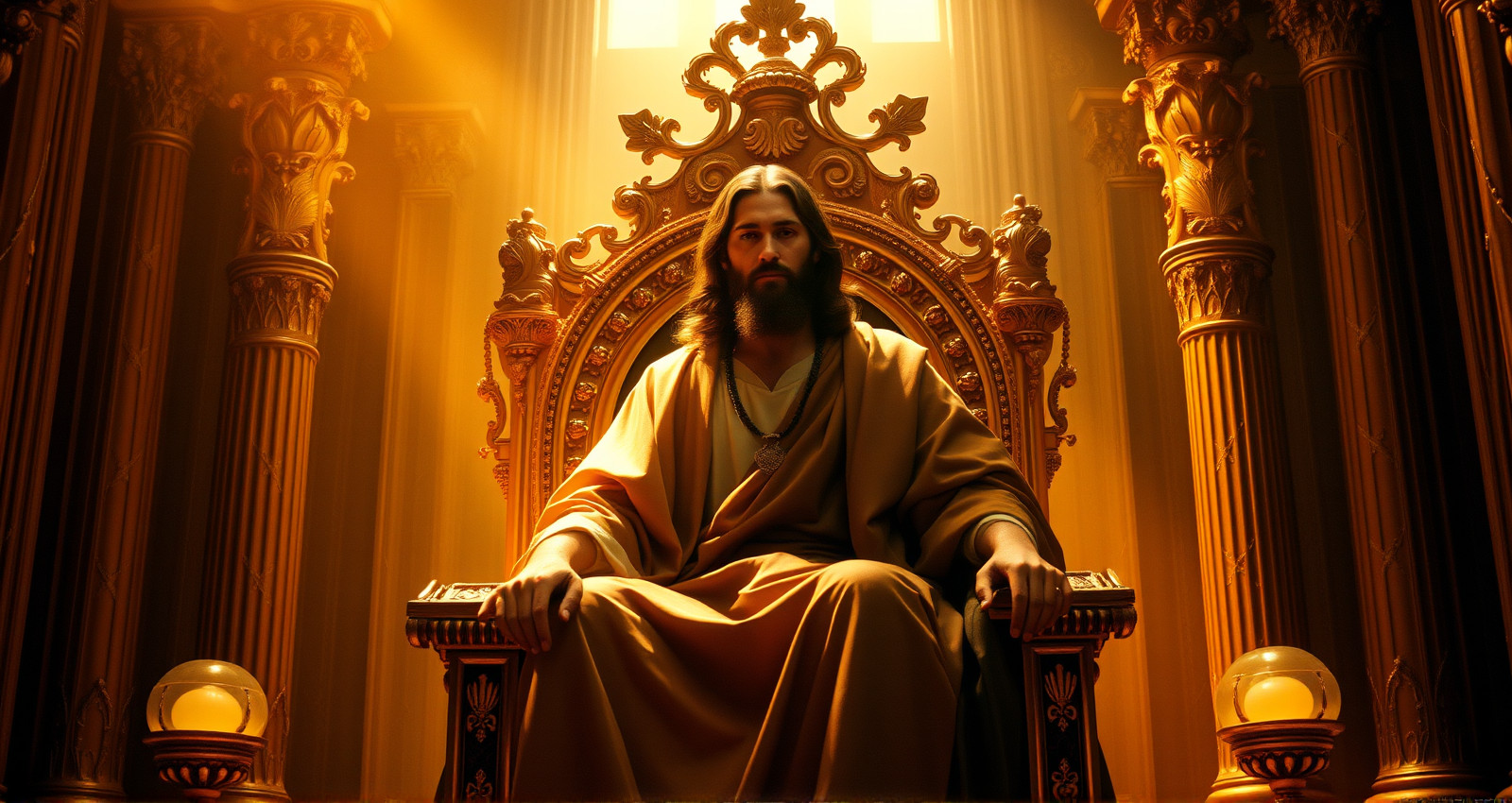
Four Kingdoms
The Scriptures mention four kingdoms: 1) the kingdom that will be established in the land of Israel; 2) the kingdom that will be established during a thousand‑year period; 3) the heavenly kingdom; and 4) the kingdom that will be established in the hearts of people. If these are not distinguished clearly, it becomes complicated and difficult to understand. Therefore, there is a need to explain them one by one.
I The Kingdom That Was to Be Established in the Land of Israel
Proclaimers
The King Who Will Reign
When a kingdom exists, it must have a king who rules it—this king is Jesus Christ.
When the Magi came to Jerusalem from the East, they asked: “Where is He who has been born king of the Jews? For we have seen His star in the east and have come to worship Him.” (Matthew 2:2)
Because of this, they called Him “the Son of David” (Matthew 9:27; Matthew 12:23; Matthew 15:22; Matthew 20:30; Matthew 21:9; Matthew 21:15; Mark 10:47; Luke 18:38).
When Pilate asked Jesus: , “Are you the King of the Jews?” Jesus said, “You have said so.”(Matthew 27:11)
Location of the Kingdom Will Be Established
These twelve Jesus sent out, instructing them, “Go nowhere among the Gentiles and enter no town of the Samaritans, but go rather to the lost sheep of the house of Israel. And proclaim as you go, saying, ‘The kingdom of heaven is at hand.’ (Matthew 10:5‑7)
This instruction makes it clear that the kingdom will be established on earth—in the land of Israel—rather than in heaven. The reason for this is that the kingdom already existed in heaven from its very beginning.
Citizens of the Kingdom
Only the people of Israel will belong to the kingdom; Samaritans and other nations are excluded. When Jesus sent out the twelve disciples he said: “Go nowhere among the Gentiles and enter no town of the Samaritans, but go rather to the lost sheep of the house of Israel.” (Matthew 10:5-6)
When a Canaanite woman asked Him to heal her daughter, Jesus replied, “I was sent only to the lost sheep of the house of Israel.” (Matthew 15:24)
Thus, the people who will be part of the kingdom that Jesus establishes are solely the Israelites.
Citizenship Requirement of the Kingdom – Entrance “Visa”
When John the Baptist appeared, he said, “Repent, for the kingdom of heaven is at hand.” He preached in Judea, saying, “Repent, for the kingdom of heaven is at hand.” (Matthew 3:2).
After John, Jesus came and began His ministry, saying, “Repent, for the kingdom of heaven is at hand.” (Matthew 4:17).
Thus, repentance is the qualification—or “visa”—for entering the kingdom.
It is important to distinguish the concept of salvation proclaimed by modern Christian believers is completely different from what Jesus and John taught at the time. Note that the gospel preached by modern Christians involves giving birth by the Holy Spirit—which refers to being born again, a concept Jesus explained to Nicodemus—was absolutely necessary to enter the Kingdom. In contrast, the kingdom John and Jesus spoke about does not require a second birth; it requires only repentance to enter it.
The kingdom preached by Christians is not on earth but in heaven; that Kingdom cannot be entered by physical means, but only through the Spirit, which necessitates being born again. When people fail to make this distinction, they often emphasize repentance as the sole requirement and criticize others for incomplete or incorrect repentance. Repentance relates to sins committed on earth and is related to the earthly kingdom that will be established.
The people of Israel are those who will become citizens of the kingdom that will be established on earth. Since they are the people of the kingdom, John wrote about them in this way:
"People went out to him from Jerusalem and all Judea and the whole region of the Jordan. Confessing their sins, they were baptized by him in the Jordan River."(Matthew 3:5‑6).
Those Not Qualified to Enter the Kingdom
The Pharisees and Sadducees also came to John to be baptized. However, John did not baptize them but warned them that they would face judgment. Why didn’t John baptize the Pharisees and Sadducees? Because they had no genuine repentance. John said to them: "You brood of vipers! Who warned you to flee from the coming wrath? Produce fruit in keeping with repentance." (Matthew 3:7-8).
From John’s words, it is clear that the Pharisees and Sadducees lacked true repentance. He saw through their hearts and told them this: “Do not think you can say to yourselves, ‘We have Abraham as our father.’ I tell you that out of these stones God can raise up children for Abraham.” (Matthew 3:9).
This means that merely being descendants of Abraham was not enough—they needed genuine repentance to become citizens of the kingdom. John warned them that they would face judgment if they did not enter the kingdom, saying: “The axe is already at the root of the trees. Every tree that does not produce good fruit will be cut down and thrown into the fire.” (Matthew 3:10). The tree represents the Pharisees and Sadducees; the axe represents judgment; and the lack of good fruit refers to their lack of true repentance, while the fire symbolizes hell.
Continuing on, John said: "I baptize you with water for repentance. But after me will come one who is more powerful than I, whose sandals I am not worthy to carry. He will baptize you with the Holy Spirit and with fire. His winnowing fork is in his hand, and he will clear his threshing floor and gather his wheat into the storehouse, but he will burn up the chaff with unquenchable fire." (Matthew 3:11-12).
Some people misunderstand what John meant by "fire baptism" and think it refers to the same as the Holy Spirit baptism. This misunderstanding is similar to the idea that appeared on the Day of Pentecost, where tongues of fire rested on the believers (Acts 2:3). However, the fire in John’s message is not the same as the fire that appeared at Pentecost. The "fire" John spoke about refers to the unquenchable fire of hell. The Pharisees and Sadducees, despite their efforts to follow religious laws, had no true understanding of God's will and were filled with pride, thinking they could enter the kingdom without genuine repentance. Therefore, they would be cast into the unquenchable fire of hell. Let us learn from them not to have a wrong attitude toward ourselves.
Attributes of the Kingdom
In the kingdom that Jesus Christ will establish, there shall be no sick people, no dead people, no lame people, and no demons. Therefore, when King Jesus sends out His disciples, He let them heal the sick, raise the dead, cleanse the lepers, and cast out demons (Matthew 10:8). It was recorded that the King Himself healed people so they may be healthy and clean, as follows:
"So his fame spread throughout all Syria, and they brought him all the sick, those afflicted with various diseases and pains, those oppressed by demons, those having seizures, and paralytics, and he healed them." (Matthew 4:24).
"That evening they brought to him many who were oppressed by demons, and he cast out the spirits with a word and healed all who were sick. This was to fulfill what was spoken by the prophet Isaiah: “He took our illnesses and bore our diseases.”" (Matthew 8:16-17).
Jesus was not only the King but also the Great Physician, who healed people. Despite being an advocate for Jesus, John the Baptist was imprisoned and not rescued, leading him to question whether Jesus was indeed the long-anticipated Messiah.
Now when John heard in prison about the deeds of the Christ, he sent word by his disciples and said to him, “Are you the one who is to come, or shall we look for another?” And Jesus answered them, “Go and tell John what you hear and see: the blind receive their sight and the lame walk, lepers are cleansed and the deaf hear, and the dead are raised up, and the poor have good news preached to them. (Matthew 11:2-5).
Why did Jesus not answer with a simple “Yes” but instead choose to elaborate on His deeds? Because it was foretold in the Old Testament that the Messiah would heal the sick, cleanse lepers, and raise the dead. By performing these works, He demonstrated clearly that He is indeed the promised One who was to come.
Two blind men
As Jesus went on from there, two blind men followed him, calling out, “Have mercy on us, Son of David!” When he had gone indoors, the blind men came to him, and he asked them, “Do you believe that I am able to do this?” “Yes, Lord,” they replied. Then he touched their eyes and said, “According to your faith let it be done to you”; and their sight was restored. (Matthew 9:27-30)
Why did the blind men call Jesus the Son of David? It is because they knew that Jesus was the one who would sit on the throne of David and also had the power to make the blind see, as the prophets had foretold. Jesus healed them according to their faith. They were healed because they were Israelites, members of God’s kingdom, so Jesus granted them what they asked for.
A Canaanite woman
A Canaanite woman from that vicinity came to him, crying out, “Lord, Son of David, have mercy on me! My daughter is demon-possessed and suffering terribly.” Jesus did not answer a word. So his disciples came to him and urged him, “Send her away, for she keeps crying out after us.” He answered, “I was sent only to the lost sheep of Israel.” The woman came and knelt before him. “Lord, help me!” she said. He replied, “It is not right to take the children’s bread and toss it to the dogs.” “Yes it is, Lord,” she said. “Even the dogs eat the crumbs that fall from their master’s table.” Then Jesus said to her, “Woman, you have great faith! Your request is granted.” And her daughter was healed at that moment. (Matthew 15:22-28)
Why didn't Jesus speak to the Canaanite woman at first, and when He did speak to her, why did He compare her to a dog? And why didn’t she become angry or discouraged but instead asked for her daughter’s healing? It was because she knew who Jesus was and understood His power and greatness. The chief priests, scribes, and Pharisees could not understand Jesus nor accept Him as their king; yet this Canaanite woman, a foreigner, recognized Jesus as king. Jesus was both a king and a great physician. Moreover, He had authority over demons. Therefore, she called Him "Lord, the Son of David." Why did the Lord Jesus not speak to her at first and even compare her to a dog? Because the Lord Jesus came only for the people of Israel, not for people of other nations.
Those who do not understand God's purpose think that God loves only the people of Israel. For that reason, they hate the Jewish people. Yet in reality, God loves not only the people of Israel but others. At Abraham’s house, it was said: "All peoples will be blessed through you." (Genesis 12:3; 18:18; 22:18; 26:4; 28:14; Acts 3:25; Galatians 3:8-9).
Jesus Himself declared: "For God so loved the world that He gave His only begotten Son, that whoever believes in Him should not perish but have everlasting life." (John 3:16) Therefore, why did the Lord Jesus come only for the people of Israel? Because He intended to establish the Kingdom of Heaven with the people of Israel as a model and then extend it to all nations throughout the world. However, because the people of Israel failed to understand His purpose, they killed their king, causing the Kingdom to be delayed until after the coming Great Tribulation.
The March to Be Anointed as King Failed
As they approached Jerusalem and came to Bethphage on the Mount of Olives, Jesus sent two disciples, saying to them, “Go to the village ahead of you, and at once you will find a donkey tied there, with her colt by her. Untie them and bring them to me. If anyone says anything to you, say that the Lord needs them, and he will send them right away.” This took place to fulfill what was spoken through the prophet: “Say to Daughter Zion, ‘See, your king comes to you, gentle and riding on a donkey, and on a colt, the foal of a donkey.’”
The disciples went and did as Jesus had instructed them. They brought the donkey and the colt and placed their cloaks on them for Jesus to sit on. A very large crowd spread their cloaks on the road, while others cut branches from the trees and spread them on the road. The crowds that went ahead of him and those that followed shouted, “Hosanna to the Son of David!” “Blessed is he who comes in the name of the Lord!” “Hosanna in the highest heaven!” When Jesus entered Jerusalem, the whole city was stirred and asked, “Who is this?” The crowds answered, “This is Jesus, the prophet from Nazareth in Galilee.”
Jesus entered the temple courts and drove out all who were buying and selling there. He overturned the tables of the money changers and the benches of those selling doves. “It is written,” he said to them, “‘My house will be called a house of prayer,’ but you are making it ‘a den of robbers.’” The blind and the lame came to him at the temple, and he healed them. But when the chief priests and the teachers of the law saw the wonderful things he did and the children shouting in the temple courts, “Hosanna to the Son of David,” they were indignant. “Do you hear what these children are saying?” they asked him. “Yes,” replied Jesus, “have you never read, “‘From the lips of children and infants you, Lord, have called forth your praise’?”And he left them and went out of the city to Bethany, where he spent the night. (Matthew 21:1-17)
Though the chief priests, scribes, and Pharisees could not understand Jesus nor accept Him as their king, Jesus ascended to receive the blessing of the Holy Spirit in the temple, just as it was prophesied. "Rejoice greatly, Daughter Zion! Shout, Daughter Jerusalem! See, your king comes to you, righteous and victorious, lowly and riding on a donkey, on a colt, the foal of a donkey." This fulfilled the prophecy of Zachariah 9:9. The people also welcomed Him with great enthusiasm. The people also shouted with a loud voice, "Hosanna to the Son of David! Blessed is He who comes in the name of the Lord! Salvation from heaven!"
However, when Jesus entered Jerusalem, the whole city was stirred up. People asked, "Who is this?" The crowd answered, "This is Jesus of Nazareth, the prophet from Galilee." But the people of Jerusalem did not know Him and did not welcome Him; they were indifferent. They asked again, "Who is this?" Yet those who followed Him from the hills were different. When someone tried to explain, he said, "He is the King," but others corrected him, saying, "No, He is the prophet Jesus of Nazareth." A prophet is lower in rank than a king, and this showed that they did not accept Jesus as their king.
How do you view Jesus? How you view Jesus will reflect in how you live your life.
The situation worsened when He entered the temple. After entering the temple, Jesus drove out those who were selling there, overturned the tables of money changers, and said, "It is written: 'My house shall be called a house of prayer,' but you have made it a den of thieves." Those in the temple were the priests and scribes, who instead of praying, were engaged in trade—selling animals for sacrifices and exchanging currency. They had turned the temple into a marketplace rather than a place of worship. Even today, many churches are more concerned with their own interests than seeking God's will. Are you one of them?
The people also shouted in the temple, "Hosanna to the Son of David!" But when the chief priests and scribes heard this, they became angry and asked, "Have you heard what these people are saying?" Why were they so upset? Because they did not accept Jesus as their king. Instead of welcoming Him, they accused Him. Although the common people accepted Him as a king, the leaders refused to acknowledge Him, so He was never anointed as king. They rejected their own king.
Kingdom of Heaven Like a Wedding Banquet
Jesus spoke to them again in parables, saying: “The kingdom of heaven is like a king who prepared a wedding banquet for his son. He sent his servants to those who had been invited to the banquet to tell them to come, but they refused to come. “Then he sent some more servants and said, ‘Tell those who have been invited that I have prepared my dinner: My oxen and fattened cattle have been butchered, and everything is ready. Come to the wedding banquet.’ “But they paid no attention and went off—one to his field, another to his business. The rest seized his servants, mistreated them and killed them. The king was enraged. He sent his army and destroyed those murderers and burned their city.
“Then he said to his servants, ‘The wedding banquet is ready, but those I invited did not deserve to come. So go to the street corners and invite to the banquet anyone you find.’ So the servants went out into the streets and gathered all the people they could find, the bad as well as the good, and the wedding hall was filled with guests. “But when the king came in to see the guests, he noticed a man there who was not wearing wedding clothes. He asked, ‘How did you get in here without wedding clothes, friend?’ The man was speechless. “Then the king told the attendants, ‘Tie him hand and foot, and throw him outside, into the darkness, where there will be weeping and gnashing of teeth.’ “For many are invited, but few are chosen.” (Matthew 22:1-14)
Why did Jesus compare the Kingdom of Heaven to a king's wedding banquet prepared for his son?
The king represents God the Father. The son of the king is none other than Jesus Christ. Those who were invited were the people of Israel. The servants who went out to gather all people were the prophets, and those who arrested, persecuted, and killed the servants were the leaders of Israel.
When the king heard this, He became angry and sent an army to destroy those killers. Because they not only killed the prophets but also the Son of the King, their city was burned down, and the people of Israel were destroyed by Roman soldiers in AD 70. The majority of today’s Jews are descendants of those who escaped unharmed and went into exile throughout the world. However, most of them today do not know God or live without faith in Him. Even those who have faith in God do not understand His will but instead follow the ways of the Pharisees and priests in their worship.
The scriptures above continue: Yet some among them did not listen. Some went to their fields; others went to trade. Those who remained behind also arrested and persecuted the disciples.
The reasons why they did not come to the banquet were because they had gone to their fields or to attend to their trade.
Many people today are like the Israelites of old—though God calls them, they ignore His call due to their own personal affairs. There is no cost to attend a wedding feast, yet they do not want to come. By refusing to come, they lose their opportunity to enter the kingdom. Even though God is calling people to attend the wedding feast of His Son in heaven, they pay no attention at all. They care more about their personal matters than about this invitation. Even when there is nothing for them to do, they still don’t want to come to the kingdom. Are you one of them? If you don't come and don't pay attention, I warn you that it is you who will suffer in the end. Do not be like the Israelites of old.
The Ambassador
While they were listening to this, he went on to tell them a parable, because he was near Jerusalem and the people thought that the kingdom of God was going to appear at once. He said: “A man of noble birth went to a distant country to have himself appointed king and then to return. So he called ten of his servants and gave them ten minas. ‘Put this money to work,’ he said, ‘until I come back.’
“But his subjects hated him and sent a delegation after him to say, ‘We don’t want this man to be our king.’ “He was made king, however, and returned home. Then he sent for the servants to whom he had given the money, in order to find out what they had gained with it.
“The first one came and said, ‘Sir, your mina has earned ten more.’ “‘Well done, my good servant!’ his master replied. ‘Because you have been trustworthy in a very small matter, take charge of ten cities.’
“The second came and said, ‘Sir, your mina has earned five more.’ “His master answered, ‘You take charge of five cities.’
“Then another servant came and said, ‘Sir, here is your mina; I have kept it laid away in a piece of cloth. I was afraid of you, because you are a hard man. You take out what you did not put in and reap what you did not sow.’
“His master replied, ‘I will judge you by your own words, you wicked servant! You knew, did you, that I am a hard man, taking out what I did not put in, and reaping what I did not sow? Why then didn’t you put my money on deposit, so that when I came back, I could have collected it with interest?’ “Then he said to those standing by, ‘Take his mina away from him and give it to the one who has ten minas.’ “‘Sir,’ they said, ‘he already has ten!’ “He replied, ‘I tell you that to everyone who has, more will be given, but as for the one who has nothing, even what they have will be taken away. But those enemies of mine who did not want me to be king over them—bring them here and kill them in front of me.’” (Luke 19:11-27)
In the above example, the ambassador is Jesus Christ Himself. The distant land He went to is heaven—the Kingdom of Heaven. Because the Jewish leaders did not accept Him and would not anoint Him as their ruler, He went up to heaven to be anointed by His Father. Therefore, when He comes again the second time, He will descend with great glory as King. Those who do not want to be under His authority are the priests, scribes, and Pharisees. The reason they not want to be under His rule? It is because they hated Him. Even though they hated Him, Jesus Christ was still be anointed by God the Father as King.
"So he called ten of his servants and gave them ten minas. ‘Put this money to work,’ he said, ‘until I come back.’ “But his subjects hated him and sent a delegation after him to say, ‘We don’t want this man to be our king.’ “He was made king, however, and returned home. Then he sent for the servants to whom he had given the money, in order to find out what they had gained with it. “The first one came and said, ‘Sir, your mina has earned ten more.’ “‘Well done, my good servant!’ his master replied. ‘Because you have been trustworthy in a very small matter, take charge of ten cities.’ “The second came and said, ‘Sir, your mina has earned five more.’ “His master answered, ‘You take charge of five cities.’"
The ambassadors who received a talent each are the believers. A talent represents the Holy Spirit, along with time, resources, and abilities that every believer receives. These are to be used for ministry and service. What kind of ministry will they carry out? The things that rise from the earth into heaven are spirits—specifically, lost spirits. Therefore, believers are called to use the Holy Spirit, along with their time, resources, and abilities, to rescue lost souls. Those who successfully rescue many lost spirits will be rewarded in heaven with great treasures.
When rescuing a lost souls, the power of the Holy Spirit is used. In addition, time, finances, and one’s skills and knowledge are also utilized. A person who earns ten talents will be given authority over ten cities. This rule will not be in heaven but on earth during the thousand years. Someone who earns five talents will be given the right to rule over five cities.
Therefore, what you invest today—your time, effort, and resources—will yield great rewards. In the coming thousand-year reign, those who have faithfully used their gifts will rule over many cities.
“Then another servant came and said, ‘Sir, here is your mina; I have kept it laid away in a piece of cloth. I was afraid of you, because you are a hard man. You take out what you did not put in and reap what you did not sow.’ “His master replied, ‘I will judge you by your own words, you wicked servant! You knew, did you, that I am a hard man, taking out what I did not put in, and reaping what I did not sow? Why then didn’t you put my money on deposit, so that when I came back, I could have collected it with interest?’ “Then he said to those standing by, ‘Take his mina away from him and give it to the one who has ten minas.’
Those who do not want to give their time, resources, and abilities in the work of rescuing lost souls are those who do not want to be under Christ’s authority, as mentioned in Matthew 14. In Matthew 27, Jesus refers to them as His enemies who do not want to accept His rule.
Even though these people receive time, resources, and abilities from Christ, they use them only for their own satisfaction rather than for the purpose God has given them. Therefore, those who are born again but do not engage in the work of rescuing lost souls—what will become of them? Will they return to hell?
The Bible clearly states in Ephesians 2:8-9 that salvation is by grace through faith, not by works. So even though these people may escape hell and reach heaven, they will receive no reward when they arrive there.
Paul illustrates this point using the example of gold, silver, and precious stones in 1 Corinthians 3:15. He says that if someone’s work is burned up (i.e., not used for God's purpose), that person will suffer loss—but still be saved, like one who escapes fire.
In the parable of Jesus, the main point is this: Jesus did not receive authority from the Jewish leaders, so His Father in heaven will give Him authority. Likewise, those who truly believe in Him are called to use the gifts they have received—time, resources, and abilities—to carry out the work He has given them, which is to rescue the lost souls.
Jesus Speaks About the Future Establishment of the Kingdom
While they were eating, Jesus took bread, and when he had given thanks, he broke it and gave it to his disciples, saying, “Take and eat; this is my body.” Then he took a cup, and when he had given thanks, he gave it to them, saying, “Drink from it, all of you. This is my blood of the covenant, which is poured out for many for the forgiveness of sins. I tell you, I will not drink from this fruit of the vine from now on until that day when I drink it new with you in my Father’s kingdom.” (Matthew 26:26-29)
Jesus dined with His disciples, an event that Christians often refer to as the Last Supper. After this meal, He was betrayed and arrested. Without delay, they took Him before Herod and Pilate, the Roman governor, for trial. During this last supper, Jesus did not talk about the establishment of the Kingdom. Instead, He spoke about a new wine that His disciples would drink in the Kingdom of the Father—a reference to the future kingdom that will be established on earth when He returns as King the second time.
Though the Jewish leaders refused to anoint Him and even crucified Him, His plans would still come to pass. Therefore, it is not enough simply to oppose God; one must understand and accept Jesus’ purpose.
In short, understanding and accepting Jesus' plan is more important than merely opposing God.
A Cirminal Accepts Jesus' Kingship
One of the criminals who hung there hurled insults at him: “Aren’t you the Messiah? Save yourself and us!” But the other criminal rebuked him. “Don’t you fear God,” he said, “since you are under the same sentence? We are punished justly, for we are getting what our deeds deserve. But this man has done nothing wrong.” Then he said, “Jesus, remember me when you come into your kingdom.” Jesus answered him, “Truly I tell you, today you will be with me in paradise.” (Luke 23:39-43)
The two criminals crucified alongside Jesus deserved death. These men represent all humanity and illustrate how most people live their lives. One of them mocked Jesus until his last breath, demonstrating that many mock Jesus until they die without ever truly knowing Him. Yet the other criminal, on the verge of death, finally understood who Jesus was—not only as an innocent man but also as the King who would establish His kingdom. He then asked Jesus to remember him when He came into His kingdom.
But how could a sinner like him understand that Jesus was sinless and the coming King? The answer lies in what Jesus said to Peter: "Blessed are you, Simon son of Jonah, for this was not revealed to you by flesh and blood, but by my Father in heaven." (Matthew 16:17). In the same way, although the Bible does not explicitly mention it, God granted this sinner understanding.
If God does not grant someone understanding, they will never understand at all. At that time, Jesus was being crucified in great humiliation and shame—there were no visible signs or indications that He would ever become King. The chief priests, scribes, and religious leaders could not recognize Him as the Messiah. For this criminal to suddenly realize that Jesus was the coming King was truly remarkable.
Even though these men were serving God’s work in their own ways—the priests through their rituals, the scribes through teaching Scripture, and the Pharisees through their leadership—they still did not understand who Jesus was. If that is the case how would God allow us to understand. We must have a desire to know Him. Jesus often expressed this longing for people to seek Him with someone who is thirsty: “If anyone is thirsty, let him come to Me and drink” (John 7:37-38). He said that those who believe in Him would experience the life-giving water of God. Do you have a desire like that criminal—to know Jesus?
Even though these men served God's work in their own ways—the priests through rituals, the scribes through teaching Scripture, and the Pharisees through leadership—they still did not understand who Jesus was. If that were the case, how would God allow us to understand? We must have a desire to know Him. Jesus often used the illustration of someone who is thirsty to represent the longing to know Him. "If anyone is thirsty, let him come to Me and drink" (John 7:37-38). Do you have such a desire—to know Jesus?
The Disciples Want to Know About the Kingdom
Therefore, when they had come together, they asked Him, saying, “Lord, will You at this time restore the kingdom to Israel?” And He said to them, “It is not for you to know times or seasons which the Father has put in His own authority. But you shall receive power when the Holy Spirit has come upon you; and you shall be witnesses to Me in Jerusalem, and in all Judea and Samaria, and to the end of the earth.” (Acts 1:6-8)
After Jesus had not only been denied kingship, but crucified by the Jewish leaders—and after He was resurrected and before ascending to heaven—He appeared to His disciples on the Mount of Olives. There, they asked Him if He would restore the kingdom to Israel. If there were no longer a plan to establish the kingdom, He would have answered that there was no such plan. However, because the kingdom would still be established in the future, Jesus responded: "It is not for you to know the times or seasons that the Father has set by His own authority." Instead, He told them that when the Holy Spirit was poured out on them, they would receive power and become witnesses to Him throughout Judea, Samaria, and to the ends of the earth.
At the end of the Great Tribulation, Jesus will return in glory with divine authority to set up His kingdom. That time is referred to as “the thousand‑year reign.” We will explore this further in the future.






REF726