
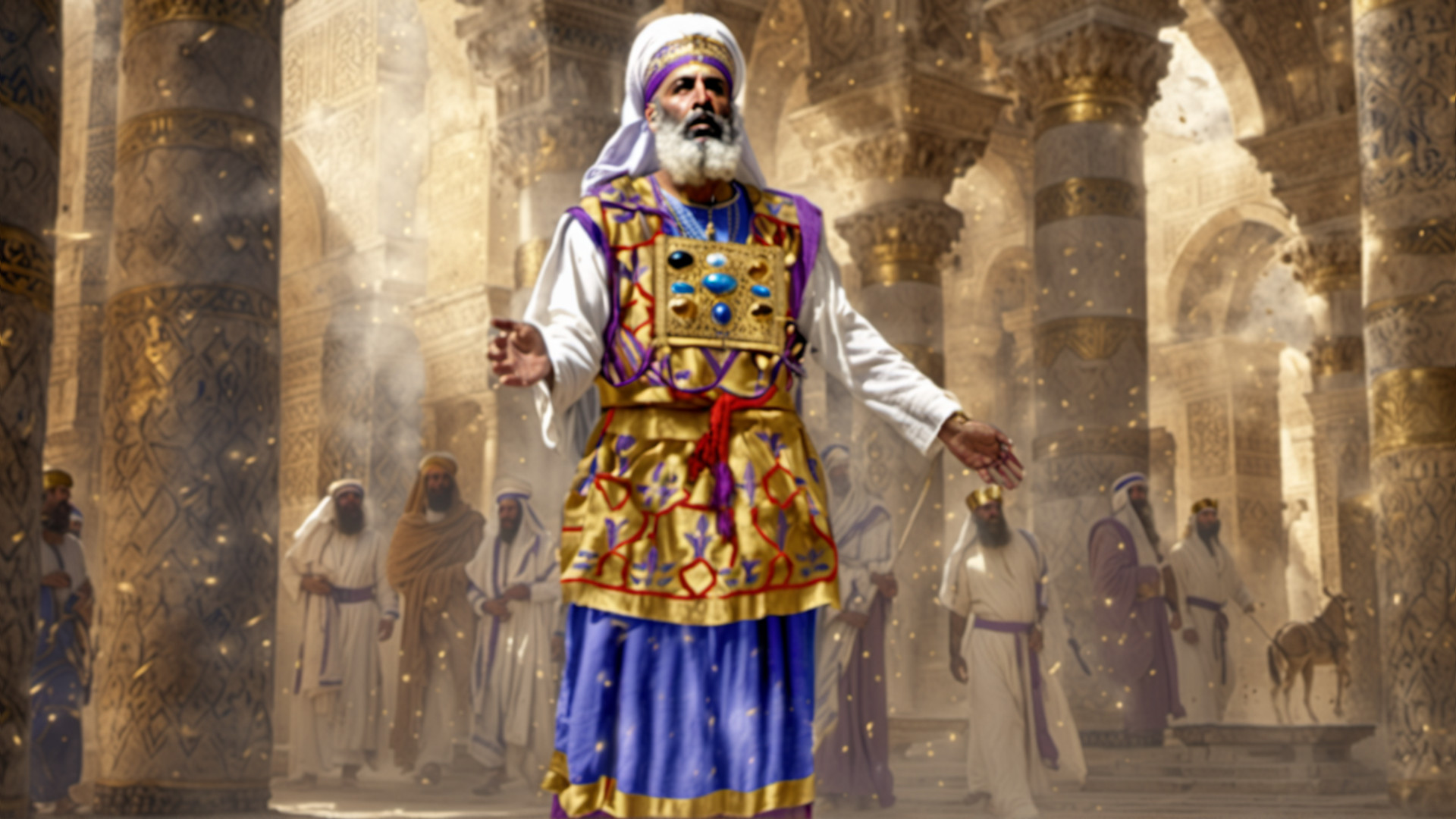
The Temple in Jesusalem
The First Temple Although God himself dwelled there, the Israelites abandoned Him and worshiped other gods; thus, in 585 B.C., the temple was destroyed by fire by King Nebuchadnezzar of Babylon. The prophet Isaiah prophesied more than two hundred years in advance that, because God's appointed time had not yet come, the Second Temple would be rebuilt under King Cyrus of Persia. The Second Temple and King Cyrus Because the Israelites did not listen to God’s word and worshiped idols, they were driven out of their land by the king of Babylon. God also permitted the destruction of the temple in Jerusalem. However, when it was God's appointed time, a prophecy made more than two centuries earlier foretold that King Cyrus of Persia (Cyrus the Great) would be commanded to rebuild the temple. God said that Cyrus is my shepherd and will accomplish all that I please; he will say of Jerusalem, “Let it be rebuilt,” and of the temple, “Let its foundations be laid” (Isaiah 44:28). As prophesied, in the second year of Cyrus's reign, King Cyrus commanded the rebuilding of the temple of Jerusalem. Ezra records this as follows: : In the first year of Cyrus king of Persia, in order to fulfill the word of the Lord spoken by Jeremiah, the Lord moved the heart of Cyrus king of Persia to make a proclamation throughout his realm and also to put it in writing: “This is what Cyrus king of Persia says: “‘The Lord, the God of heaven, has given me all the kingdoms of the earth and he has appointed me to build a temple for him at Jerusalem in Judah. Any of his people among you may go up to Jerusalem in Judah and build the temple of the Lord, the God of Israel, the God who is in Jerusalem, and may their God be with them. And in any locality where survivors may now be living, the people are to provide them with silver and gold, with goods and livestock, and with freewill offerings for the temple of God in Jerusalem.’” (Ezra 1:1-4). Therefore, the Israelites were grateful and reverent toward King Cyrus. The Second Temple began under Ezra’s leadership in 539 B.C. and was completed in 516 B.C.; sacrifices resumed there as they had been before. Those who returned from the Babylonian captivity grew zealous for God and wrote many books. The authors of these books were called scribes, while others who studied the Scriptures closely were known as Pharisees. When the Jews became zealous for God, Jesus appeared in human form to correct their errors, yet they rejected Him. In AD 33, Jesus was crucified by them. As a result, God sent Roman soldiers to destroy Jerusalem in AD 70, burning down the Temple. Afterward, they could no longer live in their homeland; instead, they dispersed throughout all provinces and lands, ceasing to offer sacrifices. Thus, the prophecy of the prophet Hosea was fulfilled: " For the Israelites will live many days without king or prince, without sacrifice or sacred stones, without ephod or household gods. Afterward the Israelites will return and seek the Lord their God and David their king. They will come trembling to the Lord and to his blessings in the last days." (Hosea 3:4-5). The Babylonians attacked Judah in 585 BC and captured its last king, Zedekiah. From that time on there was no longer a king, as the prophet Jeremiah had foretold. In 1948, when the nation was re‑established, they began living again under their own ruler. However, at the site of the Temple, Muslims built a large mosque in AD 661, preventing the Temple from being rebuilt. Since the Temple could not be rebuilt, they were also unable to perform sacrifices. The hope of rebuilding the Temple remains one of their primary aspirations. The Third Temple and Donald Trump The following verses describe the construction of the Third Temple in a detailed manner: "After the sixty-two ‘sevens,’ the Anointed One will be put to death and will have nothing.The people of the ruler who will come will destroy the city and the sanctuary. The end will come like a flood: War will continue until the end, and desolations have been decreed. He will confirm a covenant with many for one ‘seven.’ In the middle of the ‘seven’ he will put an end to sacrifice and offering. And at the temple he will set up an abomination that causes desolation, until the end that is decreed is poured out on him" (Daniel 9:26-27). “So when you see standing in the holy place ‘the abomination that causes desolation,’ spoken of through the prophet Daniel—let the reader understand— then let those who are in Judea flee to the mountains. Let no one on the housetop go down to take anything out of the house. Let no one in the field go back to get their cloak. How dreadful it will be in those days for pregnant women and nursing mothers! (Matthew 24:15-19). The "abomination of desolation" that could be interpret as "extremely wicked or evil" refers to Antichrist. God sees him as such because he wants to be God. It is like a wife who's commiting adultery is disgusting or detestable to the husband. The phrase "desolation" means waste-land, which indicates that Antichrist is a destroyer. The "holy place" refers to the temple that will be rebuilt. In this temple to be built, Antichrist will claim himself as God. Paul also wrote: "Let no one deceive you by any means; for that Day will not come unless the falling away [some interpret as apostasy or rapture] comes first, and the man of sin is revealed, the son of perdition, who opposes and exalts himself above all that is called God or that is worshiped, so that he sits as God in the temple of God, showing himself that he is God." (2 Thessalonians 2:3-4). John wrote: "Then I was given a reed like a measuring rod. And the angel stood, saying, “Rise and measure the temple of God, the altar, and those who worship there. But leave out the court which is outside the temple, and do not measure it, for it has been given to the Gentiles. And they will tread the holy city underfoot for forty-two months. " (Revelation 11:1-2). Measuring refers to ownership. When buying a house, boundaries are measured. Why measure only the temple and altar? Why not measure the land? Because God wants the Israelites to build only on the site of the temple and altar. The “land” belongs to other nations—the Muslims. When the US President Donald Trump recognized Jerusalem as the capital of Israel on December 6, 2017, the Israeli people were very happy and thankful. Additionally, news from November 10, 2016, stated that the US President and Russian President Putin were requested the building of the Third Temple. This may seem unimportant to those who do not know, but it is extremely significant for those who understand the scriptures. The second temple was built by God Himself, but the third temple was not commanded by God. All that being said, although the prophet Ezekiel spoke of building a temple (Ezekiel 40‑44), it remains unclear whether he was referring to this future third temple. Nevertheless, preparations are already underway for its construction. If permission is granted to build the third temple, it could herald a period of great tribulation. The reason is that the Antichrist will permit the Israelites to worship for three and a half years, after which he will demand that they acknowledge him as God. Whoever gives consent to build the temple could even be the Antichrist. Bottom line: The First Temple burned in 585 B.C., was rebuilt under Cyrus, destroyed again by the Romans, and its absence has sparked modern longing for a Third Temple that some see as a sign of impending tribulation. REF726