
The Greatest on Earth, the Least in Heaven
John the Greatest
Jesus said that among those born of women there has not risen anyone greater than John the Baptist. Therefore, John is greater than Herod the king who had him killed. He is also greater than Pilate, the ruler of the Jews at that time, and greater than the Roman Emperor. Moreover, he is greater than all the great rulers who ruled before, such as Pharaoh, Nebuchadnezzar, and Cyrus. He is even greater than Moses, David, Elijah, Elisha, Hosea, Jeremiah, Ezekiel, and Daniel, who were greatly respected by the Israelites. Why did Jesus call John the greatest?
The Rank of John
John the Baptist was born to Zechariah, a priest, and Elizabeth, who was barren. John wore clothing made of camel's hair and a leather belt around his waist, and he ate locusts and wild honey. (Matthew 3:4) Camel's hair is coarse and not an upper-class garment; eating locusts and wild honey also indicates poverty. He became the son of parents who were old when they had him, so it was possible that he would be poor because his parents died before he reached adulthood. Or consider this: "See, I will send the prophet Elijah to you before that great and dreadful day of the Lord comes" (Malachi 4:5) Therefore, John might have dressed like Elijah.
Jesus began to speak to the crowd about John: “What did you go out into the wilderness to see? A reed swayed by the wind? If not, what did you go out to see? A man dressed in fine clothes? No, those who wear fine clothes are in kings’ palaces. Then what did you go out to see? A prophet? Yes, I tell you, and more than a prophet." (Matthew 11:7-9)
According to Jesus’ words, those who wear fine clothes are in the king’s palace. John wore clothing made of camel’s hair and was therefore considered poor. Moreover, John lived in the wilderness and remained an unnoticed person until he proclaimed the coming of God’s kingdom for Christ. If that is the case, why did Christ say, “Among those born of women there has not risen anyone greater than John”?
Because John Worked for the Greatest King
John proclaimed in Judea: “Repent, for the kingdom of heaven has come near.” (Matthew 3:1-2).
A king is needed to establish the kingdom. Regarding that king, John said, "I baptize you with water for repentance. But after me comes one who is more powerful than I, whose sandals I am not worthy to carry. " (Matthew 3:11). The one who comes after him is the Lord Jesus Christ.
As Jesus Himself declared John the greatest, John also praised Jesus as "greater than I." The Apostle John highly praised Jesus Christ as the King of kings and Lord of lords (Revelation 17:14; Revelation 19:16). Therefore, when John the Baptist says, "He is greater than I," it means that He is the greatest King.
Nehemiah served as cupbearer to King Artaxerxes. The role of a cupbearer—essentially in charge of the royal table—might seem modest at first glance, but Nehemiah’s position was actually influential and powerful because it placed him close to the mighty king.
John the Baptist also attained great prominence because he served as the herald, or forerunner, for the King of kings.
In a similar vein, I want you to understand that if you serve the highest God—Jesus Christ—you will be declared great. Why do so many believers hesitate to preach the gospel that the Lord Jesus commanded? Because they fail to see His true greatness. How do you view the Lord Jesus?
The Least in Heaven
Why did the Lord say that John the Baptist was “the greatest on earth, yet the least in heaven”? He wanted to make clear that the heavenly kingdom is far greater than the earthly one and that its inhabitants are even more magnificent. Just as the most beautiful maiden in a village would be unnoticed when she goes to a city full of other beautiful maidens, so too do we need to recognize how vast the heavenly realm truly is. Yet many people who live only in this world seek greatness here on earth and cannot imagine what it will be like in heaven.
Heaven and Abraham
Because Abraham knew the Lord’s greatness, the author says this about him: "By faith Abraham, when called to go to a place he would later receive as his inheritance, obeyed and went, even though he did not know where he was going. By faith he made his home in the promised land like a stranger in a foreign country; he lived in tents, as did Isaac and Jacob, who were heirs with him of the same promise. For he was looking forward to the city with foundations, whose architect and builder is God." (Hebrews 11:8-10).
It is written in the book of Hebrews that the Lord called Abraham to Canaan. However, the writer of Hebrews says that Abraham looked forward to a city that God had prepared—an eternal, unshakable city. That city is in heaven.
The writer of Hebrews speaks about Abraham, Isaac, and Jacob, saying that "All these people were still living by faith when they died. They did not receive the things promised; they only saw them and welcomed them from a distance, admitting that they were foreigners and strangers on earth. People who say such things show that they are looking for a country of their own. If they had been thinking of the country they had left, they would have had opportunity to return. Instead, they were longing for a better country—a heavenly one. Therefore God is not ashamed to be called their God, for he has prepared a city for them." (Hebrews 11:13-16).
They could have returned to their original homeland in Ur, but they didn’t because they were longing for a more excellent heavenly country. Do you cling to this world or do you long for heaven? Your actions and lifestyle reveal where your heart is attached.
Heaven, the Bosom of Abraham
As we have seen above, because Abraham was drawn to heaven, the Lord described the Kingdom of Heaven as the “bosom” of Abraham. "There was a certain beggar named Lazarus, full of sores, who was laid at his gate, desiring to be fed with [a]the crumbs which fell from the rich man’s table. Moreover the dogs came and licked his sores. So it was that the beggar died, and was carried by the angels to Abraham’s bosom. The rich man also died and was buried."(Luke 16:20-22)
Again, when the Roman centurion saw Jesus with faith, he said, "And I say to you that many will come from east and west, and sit down with Abraham, Isaac, and Jacob in the kingdom of heaven." (Matthew 8:11)
The View of the Early Believers
Furthermore, "Some faced jeers and flogging, and even chains and imprisonment. They were put to death by stoning; they were sawed in two; they were killed by the sword. They went about in sheepskins and goatskins, destitute, persecuted and mistreated— the world was not worthy of them. They wandered in deserts and mountains, living in caves and in holes in the ground." (Hebrews 11:36-38)
According to the early believers, this world was unworthy of them. Do you think this world is truly suitable for you? Have you ever considered that?
Those who aspire to go abroad are often willing to sacrifice comfort at home, even if they could live in a spacious house, because the allure of life overseas is stronger. They are prepared to endure a modest apartment, confident that a foreign land will offer greater comfort, opportunities, and luxuries.
Paul's View on the World
Paul wrote, “Jesus gave himself for our sins so that we might be rescued from this present evil age, according to the will of our God and Father” (Galatians 1:4). He saw the world as corrupt. How do you view it? Your perspective will shape your life. If you see this world as entirely good, you may be less inclined to hope for heaven and more focused on enjoying earthly pleasures. Conversely, if you regard this world as unworthy of such enjoyment—just as early believers did—you’ll look forward to heaven and live with that expectation in mind.
The Kingdom to Be Established on the Earth
John the Baptist proclaimed that the Kingdom would be established on earth. For this purpose, Jesus sent the twelve disciples, saying: “Do not go among the Gentiles or enter any town of the Samaritans. Go rather to the lost sheep of Israel. As you go, proclaim this message: ‘The kingdom of heaven has come near.’” (Matthew 10:5‑7). Thus, the Kingdom was intended to be established in Canaan with only the people of Israel—not among other nations.
There Shall Be No Sickness in the Kingdom
The Old Testament prophesied that in the kingdom which the Lord Jesus will establish, all will be made well: the blind will see, the deaf will hear, the lame will leap like deer, and the mute will sing (Isaiah 35:5-6). In accordance with this, the disciples were told, "Freely you received, freely give. Heal the sick, raise the dead, cleanse the lepers, and cast out demons" (Matthew 10:8).
Therefore, Jesus told two disciples whom John had sent to learn about Him, “Go back and report to John what you hear and see: 5 The blind receive sight, the lame walk, those who have leprosy[a] are cleansed, the deaf hear, the dead are raised, and the good news is proclaimed to the poor." (Matthew 11:4-5). By doing these things, He showed that He was indeed the one they had been expecting.
The View of the Canaanite Woman
In the Scripture, it is written that the Canaanite woman saw Jesus as a King who could heal:
A Canaanite woman from that vicinity came to him, crying out, “Lord, Son of David, have mercy on me! My daughter is demon-possessed and suffering terribly.” Jesus did not answer a word. (Matthew 15:22).
Why did the Canaanite woman call Jesus "the Son of David"? Because she saw Him as a King who could overcome demons. Why didn't Jesus say even one word to her? The Lord said, "I was sent only to the lost sheep of Israel." (Matthew 15:24) He came only for the people of Israel. That means that others have no share or benefit.
When she approached Him and cried out, "Lord, save me," He replied, “It is not right to take the children’s bread and toss it to the dogs.” “Yes it is, Lord,” she said. “Even the dogs eat the crumbs that fall from their master’s table.” Then Jesus said to her, “Woman, you have great faith! Your request is granted.” And her daughter was healed at that moment. (Matthew 15:26-28). Why did the Canaanite woman keep asking? Because she knew that Jesus could give her what she wanted. Jesus compared the Canaanite woman to a dog.
However, she didn't get discouraged and kept asking. At that moment, Jesus said "“Woman, you have great faith! Your request is granted.” Here, "Woman" was an expression of admiration.
When the Israelites, who were God's chosen people, couldn't see Jesus as He truly was, the Canaanite woman saw Him clearly, which is amazing. Therefore, she received what she wanted. The demon in her daughter left and she became healthy.
Are you like the Israelites or like the Canaanite woman? Your actions will show.
Repentance is Required to Become a Citizen
In the Kingdom that the Lord Jesus will establish, repentance is required to be a citizen. John said, "The kingdom of heaven is at hand. Therefore, repent," he preached in Judea (Matthew 3:1-2). At that time, from Jerusalem and all over Judea, people who lived near the Jordan River went out to John, confessing their sins and being baptized in the Jordan River (Matthew 3:5-6). John gave baptism in water as a sign of repentance to the people of Judea. Therefore, those people became citizens of the Kingdom.
However, when John the Baptist saw many of the Pharisees and Sadducees coming to where he was baptizing, he said to them: “You brood of vipers! Who warned you to flee from the coming wrath? Produce fruit in keeping with repentance." (Matthew 3:7-8). Why did John not only refuse to baptize the Pharisees and Sadducees but also called them a brood of vipers? The reason is that they did not confess their sins nor show true repentance.
Why Do They Not Repent?
The Pharisees and the Scribes are considered to be those who have great reverence for God and are learned men, so they believed that repentance was unnecessary. John could see this in their hearts. For that reason he said to these people: " And do not think you can say to yourselves, ‘We have Abraham as our father.’ I tell you that out of these stones God can raise up children for Abraham."(Matthew 3:9) Because they are descendants of Abraham, they think that they are automatically citizens of the kingdom and do not need to repent or expose their sins.
Therefore, John said, "The ax is already at the root of the trees, and every tree that does not produce good fruit will be cut down and thrown into the fire. “I baptize you with water for repentance. But after me comes one who is more powerful than I, whose sandals I am not worthy to carry. He will baptize you with the Holy Spirit and fire. His winnowing fork is in his hand, and he will clear his threshing floor, gathering his wheat into the barn and burning up the chaff with unquenchable fire.” (Matthew 3:10-12). John told them that instead of receiving baptism, they would face judgment. Just as the tree was cut down and thrown into the fire, Jesus will judge them. They are like wheat, and they will be burned by unquenchable fire.
Are you someone who will either be cut down like a fruitless tree or burned up like chaff?
Lord Jesus Receives Baptism
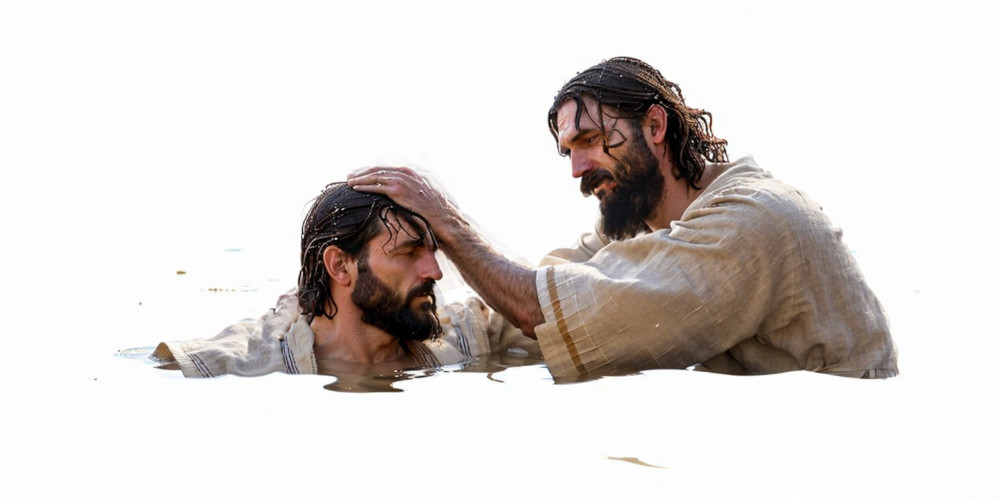
Then Jesus came from Galilee to the Jordan to be baptized by John. But John tried to deter him, saying, “I need to be baptized by you, and do you come to me?” Jesus replied, “Let it be so now; it is proper for us to do this to fulfill all righteousness.” Then John consented. (Matthew 3:13-15).
John had given baptism to the Jews, but he warned the Pharisees and Sadducees that they would face judgment. On that day, Lord Jesus also went to John to be baptized. At first, John refused because of his humility. However, when Jesus said that it was necessary for Him to fulfill all righteousness, John gave Him baptism. The baptism of Lord Jesus was not only to fulfill all righteousness, but also to show that He is the Son of God.
As soon as Jesus was baptized, he went up out of the water. At that moment heaven was opened, and (John) saw the Spirit of God descending like a dove and alighting on him. And a voice from heaven said, “This is my Son, whom I love; with him I am well pleased.” (Matthew 3:16-17).
John Did Not Know Jesus
Regarding this matter, John said: " I did not know Him, but He who sent me to baptize with water said to me, ‘Upon whom you see the Spirit descending, and remaining on Him, this is He who baptizes with the Holy Spirit.’ And I have seen and testified that this is the Son of God." (John 1:33-34).The reason Jesus received baptism was to make it clear that He is the Son of God. Did Jesus need to repent like the Jews? No. Was John’s initial refusal to baptize him due to an unclean heart, as the Pharisees and Sadducees had? No. It was because John felt he was unworthy to baptize Him. Later, however, he did baptize Jesus.
Heavenly Citizenship Visa
The heavenly kingdom that John proclaimed is not a realm in heaven; it will be established on earth. Therefore, the “second birth” (being born‑again) that contemporary Christians discuss differs from what many traditionally understand. The visa for entry into this kingdom is repentance itself.
So how were they supposed to repent?
So the people asked him, saying, “What shall we do then?” He answered and said to them, “He who has two tunics, let him give to him who has none; and he who has food, let him do likewise.” Then tax collectors also came to be baptized, and said to him, “Teacher, what shall we do?” And he said to them, “Collect no more than what is appointed for you.” Likewise the soldiers asked him, saying, “And what shall we do?” So he said to them, “Do not intimidate anyone or accuse falsely, and be content with your wages.”
The Kingdom of Heaven Suffered Violence
From the time of John the Baptist until now, people have been taking the kingdom of heaven by force. Those who take it by force also suffer violence. (Matthew 11:12-13)
The phrase “from the time of John the Baptist until now” refers to a relatively short period. John began his ministry around AD 30 and served for only a few months—or about a year—before Jesus’ crucifixion. Why, then, does it say, “From the time of John the Baptist until now people have been taking the kingdom of heaven by force, and those who take it by force also suffer violence”? When John declared that the kingdom of heaven was near, not only Jews but also Pharisees and Sadducees began to want to enter.
They have taken the kingdom of heaven by force. Those who take it by force also suffer violence. Who are these people taking the kingdom of heaven by force? How do they suffer violence? The Pharisees and Sadducees, who too desire to enter, lack the repentance that John and Jesus taught. They think that because they are descendants of Abraham, they automatically belong to the people of the kingdom of heaven. Therefore, a struggle against the King of the kingdom of heaven—Jesus Christ—persists throughout all time.
No Respect to the King
Wise men from the East asked, “Where is he who has been born king of the Jews?” (Matthew 2:2). When Herod heard this, he "called together all the people’s chief priests and teachers of the law, he asked them where the Messiah was to be born. 5 “In Bethlehem in Judea,” they replied, “for this is what the prophet has written: “‘But you, Bethlehem, in the land of Judah, are by no means least among the rulers of Judah; for out of you will come a ruler who will shepherd my people Israel. (Matthew 2:4-6)
Although they could immediately identify where the Jewish king would be born, did they search for him? No—they did not. Why not? Because they did not accept Jesus as their King.
You also celebrate Christmas every year—many consider it the Lord’s birthday. But do you truly accept Him as your King? If so, following His will should become your top priority. You would joyfully carry out whatever He directs.
Robbing the House of Widows
How did the Pharisees rob the House of the Widows? Jesus said: “Woe to you, scribes and Pharisees, hypocrites! For you devour widows’ houses, and on a pretense make long prayers. Therefore you will receive greater condemnation.” (Matthew 23:14)
The widows gave generously to the Pharisees because they regarded them as God’s people and leaders of the Kingdom. Yet did the widows themselves not give willingly? Why then did Jesus say that the Pharisees “robbed the house of widows”? The reason is that, although the Pharisees claimed citizenship in the Kingdom, they had no right to enter it.
Later Jesus speaks again about the Pharisees: “Many will come from east and west and recline at the table in the kingdom of heaven with Abraham, Isaac, and Jacob. But the sons of the kingdom will be cast out into outer darkness; there will be weeping and gnashing of teeth.” (Matthew 8:11‑12)
Future King of the Kingdom Killed
The priests, scribes, and elders were religious leaders, yet they did not accept Jesus as the Messiah. Without royal permission, however, they stirred up unrest in a crucial position within the kingdom. Finally, Pilate asked them again, "What shall I do with this man called the King of the Jews?" They shouted back, "Crucify him!" (Mark 15:12-13). Again, Pilate said to the Jews, "Look, your king!" They cried out, "Away with Him! Crucify Him!" Pilate asked again, "Shall I crucify your King?" The chief priests replied, "We have no king but Caesar." (John 19:14-15).
In reality, the people had accepted Jesus as their king; yet because the religious leaders did not accept him, they denied him authority.
Are you acting as a servant of God who is hindering people from accepting Jesus, like those religious leaders? Or are you someone who disbelieves in Jesus because of the deception of the religious leaders? Think carefully.
Two Dying Criminals
One of the criminals who were hanged blasphemed, saying, "If you are the Christ, save yourself and us." But the other rebuked him, saying, "Do you not fear God, seeing that you are under the same condemnation? We indeed justly, for we receive what we deserve; but this man has done nothing wrong." Then he said, "Jesus, remember me when you come into your kingdom." Jesus said to him, "Truly I tell you today, you will be with me in Paradise." (Luke 23:39-43)
At the time of Jesus’ crucifixion, two criminals were nailed to either side of Him. One of them did not believe in Jesus even up until his death. This criminal represents those who refuse to accept Jesus even at the point of death. Are you like that man? Repent!
The other criminal believed in Jesus not only at the moment of his death but also accepted Him as ruler of His kingdom. Therefore, on that day Jesus granted him the privilege of entering heaven. He said to the criminal, “Today you will be with me in Paradise.” Although this criminal had committed a crime so severe that it deserved crucifixion and was about to die, because he accepted Jesus before dying, he entered Heaven immediately after his body died. For that reason, his life became meaningful.
You too should now accept Jesus as your Lord, just as the criminal did before his death. If you do, you will be granted the privilege of entering heaven.






REF726